
Dating Across the Divide: How Transparency-Prioritizing and Autonomy-Prioritizing Polyamorists Can Actually Make It Work
Strategies for Loving Across Different Poly Frameworks Without Losing Yourself

In a previous piece, I mapped four distinct types of polyamorists, each shaped by different upbringings, different core wounds, and therefore different ideas about what safety in a polyamorous relationship actually requires.
Transparency-prioritizing polyamorists center open communication and ongoing radical disclosure. They like creating thorough agreements around sex and boundaries. Not to control their partners, but to feel emotionally and physically secure. Transparency is how they build trust, and stay grounded in both their bodies and their relationships.
Example: they want to be informed before their partner is about to sleep with someone new, not after.
Autonomy-prioritizing polyamorists center freedom and minimal disclosure. They often experience explicit lengthy agreements as restrictive, and may prefer privacy or don’t-ask-don’t-tell dynamics. For many they developed this framework in environments where self-direction and secrecy/privacy were necessary for survival, where being known fully meant being controlled or wasn’t generally safe.
Example: they want to be able to act on sexual desire spontaneously, without checking in first.
Adaptive-connecting polyamorists can move fluidly between these two frameworks without losing themselves. They negotiate, hold space for multiple needs, and adjust agreements as relationships evolve.
Example: They’re comfortable giving a partner advance notice before sleeping with someone new when that’s what the partner needs, and they’re equally comfortable in relationships where disclosure happens afterward, once a new sexual connection has already occurred.
One-sided polyamorists
These polyamorists want full freedom for themselves while demanding high transparency from their partners. They resist disclosing their own actions while closely monitoring others’. This imbalance often shows up as one-sided control.
Example: They need to know before their partner has sex with someone new, but they don’t want to have to share the same information in return.
I polled my Instagram following of 330K followers on where they fall, and it was pretty evenly spread for the most part.
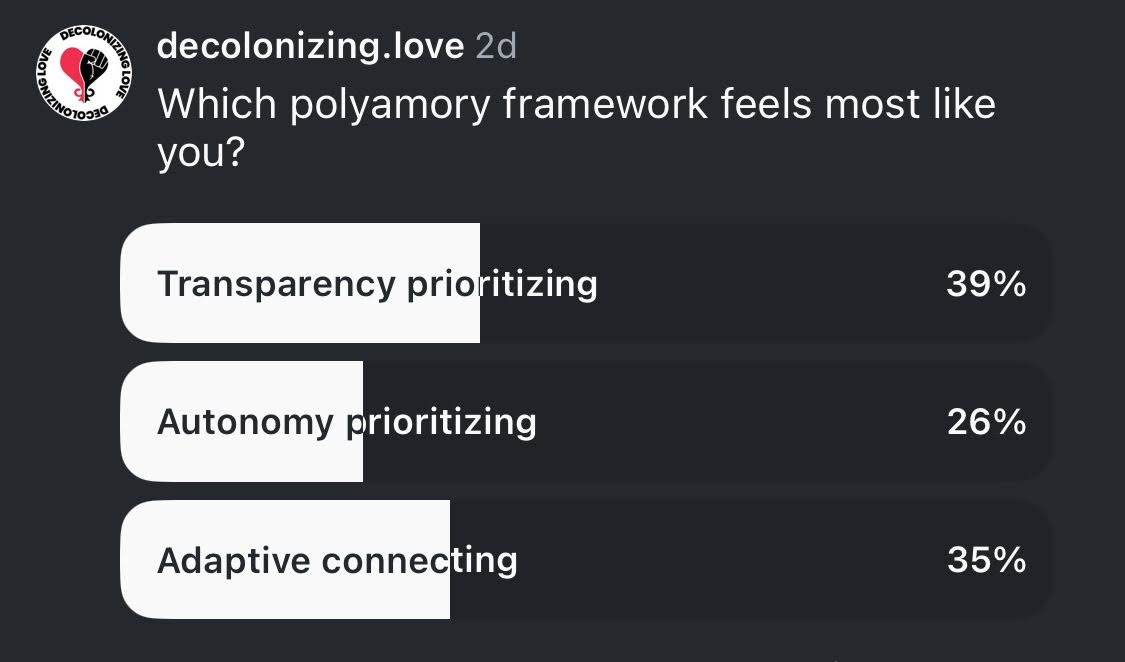
Every time I write about my 4 polyamorous boundary frameworks, hundreds of people message me across my socials saying they relate and asking for advice, especially about how couples where one person is an autonomy-prioritizing polyamorist and the other is a transparency-prioritizing polyamorist can resolve their differences and create agreements they’re both genuinely happy with.
I have my own experience from coaching people through these dynamics, as well as from my own dating life. But I also asked my facebook audience what has worked for them, and many shared strategies I hadn’t considered before. What emerges from all of those voices is something far more textured and useful than any theory I could write alone: real, hard-won ways these two camps can date without harming each other, or themselves.
This piece is my synthesis of all of that. It’s not a promise that every pairing between an autonomy-prioritizing and a transparency-prioritizing polyamorist will work. Some won’t. But for the ones that can, these are the practices that can make it possible.