
Decolonizing Love: An Invitation
How an accidental journey to unlearn empire became a movement to decolonize our intimacy.

I don’t believe in asking for support; I’d rather give people something that lights a path and let them decide if they want to walk alongside me. Decolonizing Love was never meant to be a brand. It became a movement because people were looking for answers and illumination of colonial history that is purposely erased. Yet this project, this whole decolonizing journey, has grown far beyond anything I imagined. It keeps reshaping itself through the communities that gather around it, as though the work has its own momentum and I’m simply following where it leads.
The largest polyamory education audience in the world: 500,000+ learners across platforms (as of Dec 2, 2025).
Walk this path with me: become a paid member for full essays, tools, and our members-only podcast.
I came to Canada to realize my goal of being a writer, certainly not a political educator speaking about polyamory through a decolonial lens. That part was serendipity. What wasn’t accidental was the path that shaped me long before this platform existed: being raised between worlds, between cultures, between languages, watching, even as a child, how colonialism had rearranged family, intimacy, and identity.
I am a rebel who comes from rebels. An Italian grandfather disowned for loving an African woman, then using his whiteness to evade British authorities and smuggle weapons to Kenya’s Mau Mau freedom fighters. His son, my father, spent his life committed to the Palestinian struggle, raising us between Jerusalem, the Golan Heights, and the West Bank.
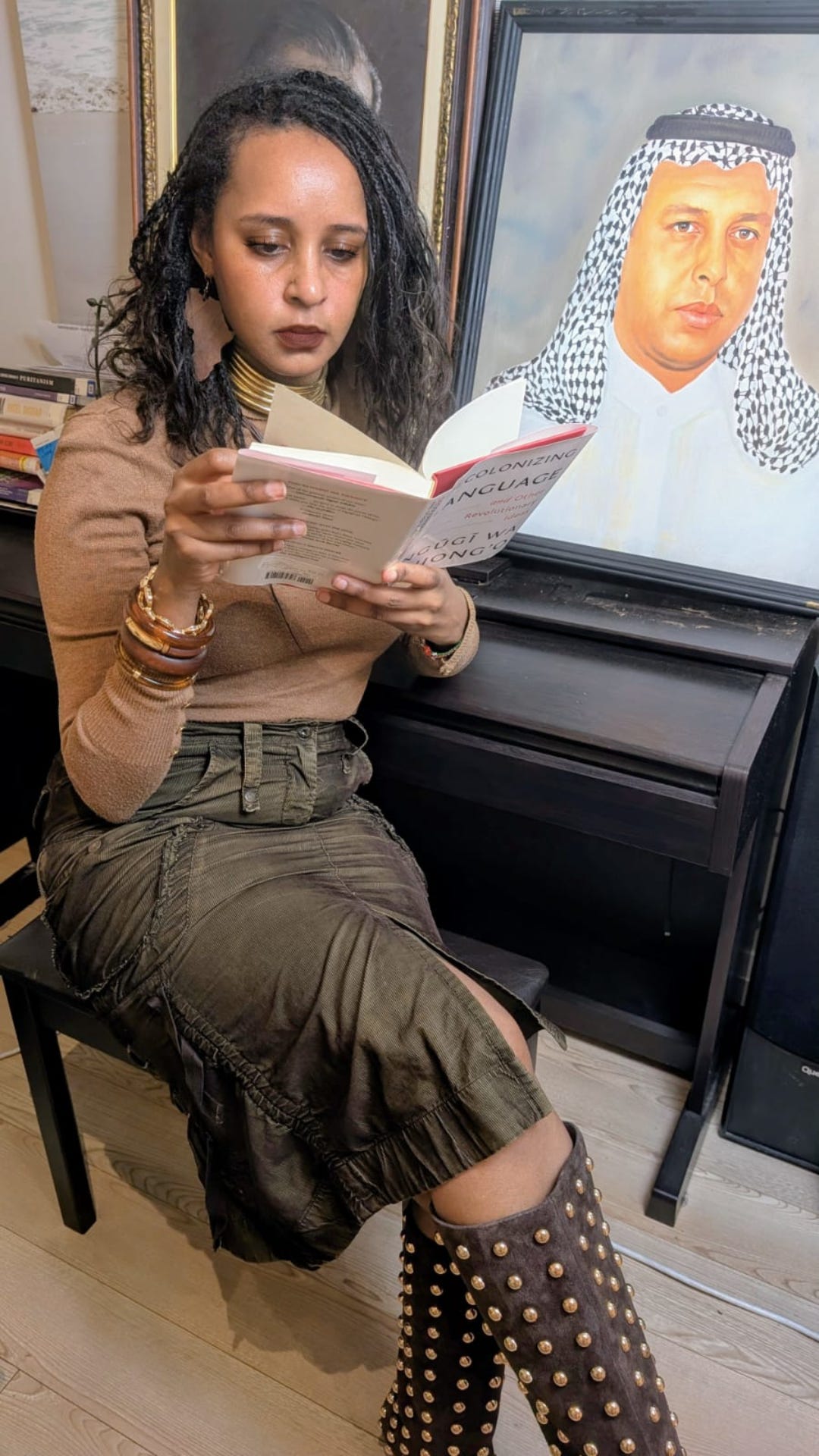
(My father’s portrait besides me, Ngũgĩ’s words in my hands.)
On my mum’s side, we’re a unique mélange of Kenyan Indigenous cultures and also part Asian. My mum mostly identifies as Kikuyu, and I can see why, Kikuyu women are famously among the strongest in Kenya. All the Kikuyu clans are named after the first daughters of the tribe. And women can marry themselves in the Kikuyu tradition, as two of my aunts did.
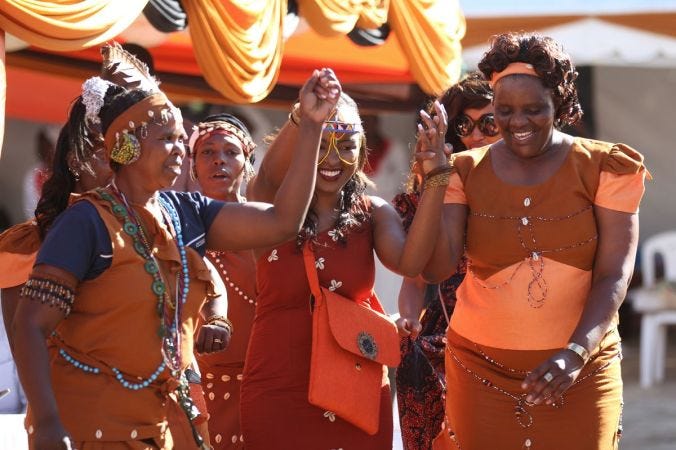
(Kikuyu wedding)
Soon after learning it, I was banned from speaking my mother’s Kikuyu tongue at age three so I could assimilate into private British and American international schools. Still, I whispered it under my breath because it felt closest to who I was. And then, in university in Canada, I found Ngũgĩ wa Thiong’o’s Decolonising the Mind, a book from my mother’s Kikuyu lineage that had been censored in Kenya and exiled abroad. Suddenly all the contradictions I’d grown up inside made sense: the ways empire lingers after independence, shaping how we think, the languages we speak, how we love, and who we continue to obey.
If colonialism engineered our cultures, our languages, even our kinship structures to this day, then of course it shaped our relationships too. Of course compulsory monogamy didn’t descend from the sky. It was designed, an administrative technology of empire, tied to land, inheritance, the church, and the state. That realization cracked something open in me: if our minds and relationships were still colonized, then liberation meant unlearning and working to decolonize both the mind and love.
That is how Decolonizing Love began, not as branding or strategy, but as a question I could not put down and one that I needed to continue digging deeper into.
Between 2017 and 2019 in Toronto, I was organizing meetups for polyamorists of colour because there were no real spaces built with us in mind. My meetups were always full. People began asking for teachings. I obliged and ran free workshops, but I wanted something deeper, something I could learn from too. Polyamory 101 felt uninspiring to me; anyone could find that from any polyamory educator. So I asked the group for an exchange.
That became the first Decolonizing Love workshop: a space where people were given homework, to speak with their grandparents about decolonial love, and then return with ancestral teachings to share, teaching all of us how to unlearn and what the best practices for a decolonial love might be.
The workshop was so popular I was asked for an encore, but I had been doing it for free and was depleted. Still, I wanted to honour that request in a way that felt sustainable.
When the pandemic hit, I decided to use the unexpected free time to put the workshop online in bite size format. To my surprise, it went viral. I never imagined so many people would connect with something I had been privately researching for a decade. The relationship between colonization and intimacy. The residue of empire inside our expectations. The possibility of loving outside inherited scripts. Recovering relational practices from Indigenous cultures and translating them for our contemporary lives.
But I was not prepared for the backlash either. A few months into decolonizing love, I had a post get 3 million views in 72 hours and received ten thousand people attacking me for being polyamorous. I hadn’t signed up for abuse. I stopped content creating and took refuge in British Colombia’s Rockies to think if i wanted to continue on this path I hadn’t actually chosen. Yet even there the messages kept coming, people saying decolonizing love’s work helped them survive heartbreak, survive war, survive themselves. One person tattooed my words on their body. A Ukrainian follower told me my work helped her imagine the freedom she was fighting for.
After a few months in the mountains I emerged, and stopped resisting the path and began walking it with intention.
That is because there is no one else doing decolonization and polyamory education in the way I do it: drawing from my African indigenous lineages; from lived experience across Palestine, Cambodia, The Netherlands and Turtle Island; and from research in social anthropology, liberation movements, and decolonial praxis.
I’ve now begun pursuing graduate studies in this very subject, guided by the blessing of Ngũgĩ wa Thiong’o on my decolonizing theorizations and affirmed by a member of Dedan Kimathi’s family, Kenya’s national hero of independence.
And I want this work to go even further: into field research with elders, into archiving pre-colonial relational practices, into creating tools that don’t exist anywhere else, like our relational agreement generators built on questions that dig far deeper than the surface-level scripts we’ve inherited from compulsory monogamy culture. Our agreement generators were born from community requests, after people learned about the relationship agreement we had crafted for our own lives.
This is slow work. Deep work. It requires travel, interviews, research, and the time to think critically. I want to return the left to rigorous inquiry, to discomfort, to theory rooted in liberation rather than performance. And I want to keep offering this to everyone who hungers for it.
If you believe in this work, if you want more of the tools, the histories, the research, the analysis, the stories, the transcriptions from elders, the uncomfortable questions that open new worlds, then becoming a paid subscriber is one of the most powerful ways to sustain it. Not as charity, but as participation in the kind of future we’re building together.
I’ll keep walking the path either way, as I always have. But if you want to walk it with me more closely, more intentionally, I’d love to have you on the inside of this work.
What paid members receive
Member eBook: Practical Safer Sex for Polyamorists—Everywhere (instant download + free updates)
2 deep‑dive essays each month: research‑backed, citation‑rich
Early access: first dibs (and member pricing) on workshops, new agreement generators and live events
Members‑only podcast: Nick & Millie Debate Substack‑exclusive audio for paid members
Shaping the work: vote on research priorities + occasional behind‑the‑scenes field notes
Membership isn’t charity. It’s participation in building the future’s relationship toolkit.
Walk this path with me. Join as a paid member.
FAQs
Can I cancel anytime? Yes, monthly or annual, cancel whenever you need.
Is there a sliding scale for workshops? If cost is a barrier, we maintain community‑supported spots, reach out and we’ll make it work.
Is this only for polyamorous people? No. Many monogamous and poly‑curious readers use the tools to unlearn empire in their relationships.
Will I keep getting free content? Yes, some of our essays will be free. Paid members help fund deeper research and get tools, podcasts and all our essays first.
Everything I read of yours triggers multiple realizations about colonial structures in my own mind and behavior, many of which aren’t obviously related to the original topic, or even polyamory. And always in a way that inspires me to continue growing rather than fall into despair or crippling guilt. I finally visited, and subscribed to, your substack after only seeing your fb and insta content and I’m so glad I did (side note: your recent posts about financial compensation for activism work probably played a role in my timing 🤣). Anyway, I just wanted to leave a comment somewhere to say that I broadly appreciate your work, and that engaging with it makes me a better person. This seemed like the right article to do it on 😊.