
Polyamory Under the Law
From locked hospital doors to radical relationship agreements: A manifesto for the families the colonial state doesn't recognize.

Think about the people who would be in the room with you at the worst moment of your life.
You are lying beneath harsh ICU lights, half-conscious under the smell of disinfectant and the constant static of machines. The person who has held you down through every other hard moment is waiting behind a locked hospital door for someone at reception to buzz them in. The partner who can read your face before you speak. The friend who became more family than your blood relatives years ago. The metamour who helped raise your child. The chosen sibling you have called at least once a month for twenty years.
Now think about who the hospital will actually let past reception.
In most places in the world, the answer comes down to a single document filed with the local registry. One that says you and another person are legally married, you’re the legal parent, or legally related by close genetic material. Everyone else, no matter how deeply you love each other, is treated as a visitor at best and a stranger at worst.

If you have ever hesitated before saying my partner or my partners in front of a coworker. If you have ever decided not to bring all your loves to a family event because it would create strife. If you have ever left someone off an emergency contact form because there was only room for one name, this piece is for you.
What follows is the story of how that legislation and those norms came to control our lives, what dignities they rob us of, what a small group of North American cities have started doing to rectify them, and toward the end, what we can begin to reclaim tonight, in the way we talk to the people we love, without waiting for a single law to pass.
A Moment of Relief in Portland
When Amy Nash-Kille heard that Portland, Oregon had passed an ordinance in March 2026 protecting polyamorous people from discrimination in housing, jobs, and public accommodation, she called it “one of the greatest relief moments of our lives.” She has spent seventeen years raising four children with two partners. Before living in Portland, her polyamorous life required hiding it from her graduate school adviser, her coworkers, and her hairdresser. A polyphobic stranger nevertheless harassed her family for over a year. They got a restraining order but it wasn’t enough. They had to leave Colorado.
The legal system offered this family almost no protection, and that absence gave people hostile to polyamory room to act with impunity, ultimately forcing them from their home state.
Most polyamorists reading this can relate to Amy’s experiences and calculations, even if theirs have never been quite as severe, like the daily hesitation over which photo to put up on a work desk. The wedding you weren’t invited to because the host didn’t know how to introduce you and all your partners. The lease application that asked for spouse and children and had no field for all the people you actually live with. The doctor's office form. The benefit plan form. The bank form. The school form. Each one a cutting reminder that compulsory monogamy culture does not recognize yours as a real family or real relationship.
Legal erasure is a form of violence.
A 2024 survey by the Organization for Polyamory and Ethical Non-monogamy (OPEN) found that 60% of non-monogamous people report stigma or discrimination in healthcare, custody, or family settings. It shows up in tax codes built around two-person couples, in custody battles where a judge treats non-monogamy as evidence of unfit parenting, in zoning rules that make it illegal for more than a small number of unrelated adults to share a home.
The U.S. cities now extending polyamorous legal protections: Somerville, Cambridge, and Arlington (MA); Oakland and West Hollywood (CA); Olympia (WA); Portland (OR), with Seattle, Eugene, Astoria, and Hazel Park (MI) in the queue, are liberating their polyamorous citizens. But celebrating these legal wins, without asking why these laws existed in the first place, misses some important points. Domestic law has long functioned less as a neutral arbiter of love than as a tool of population control. Family regulation has been one of the state’s most reliable mechanisms for enforcing conformity and domination, not to protect families themselves, but to preserve systems of power that depend on people being disciplined within narrow social constraints.
The Invention of the Nuclear Family
Modern culture treats marriage and the nuclear family as if they were natural and primordial, and as if gender egalitarian polyamory was a recent deviation. The historical record suggests it’s actually the total opposite.
For 99% of human history, marriage did not exist. Anatomically modern humans have been around for roughly 300,000 years, yet the earliest written marriage records appear in Mesopotamia only about 4,350 years ago. Marriage covers a mere 1.5% of our collective timeline.
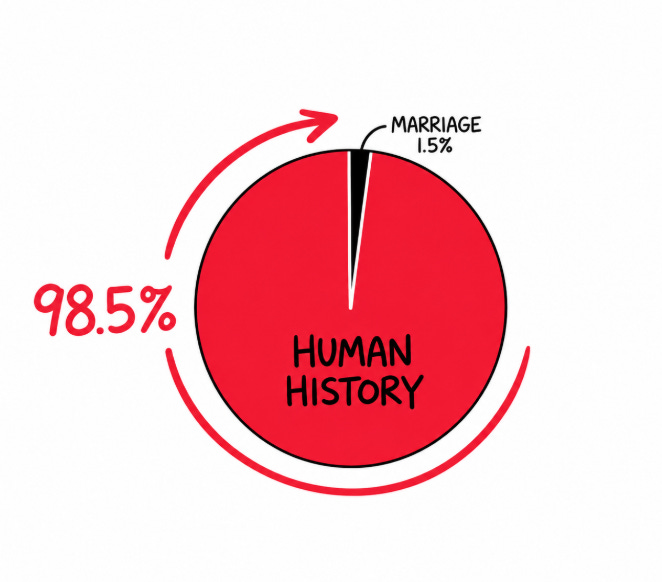
For a glimpse into how humans organized themselves for 98.5% of our history, anthropologists look to contemporary hunter-gatherer societies. Groups like the Hadza of Tanzania and the !Kung San of the Kalahari have been studied for decades by Frank Marlowe and Richard Lee. What they found was serial monogamy, pairing up for a few years, drifting apart, then finding someone new without paperwork or legal contracts was the norm among these groups. The Hadza do not even have a word for “husband.” The closest term translates to “the man I am currently with.”

Children there grow up with siblings from different fathers, raised by dozens of people who all help feed and protect every child in the community. This is what evolutionary anthropologist Sarah Hrdy calls cooperative breeding. Parents never parent alone.
Biological anthropologist Helen Fisher has argued that human pair bonds are naturally built to last about four years. Which is just long enough to get an infant past its most vulnerable phase. When she analyzed divorce data across 60 countries, the peak of marital dissolution clustered around year four. Our romantic bonds, this suggests, was designed for “until the child can keep up with the band,” not “until death do us part.”
The modern marriage we treat as natural is, on the actual timeline of our species, a recent and unusually demanding experiment.
Marriage Has Always Been About Property
Marriage did not begin with love. It began with wheat.
About 12,000 years ago, humans started farming. The moment we began owning fields and herds, a new problem appeared: how do you make sure the land and livestock are passed down across generations? Hunter-gatherers never owned land or much property, so inheritance did not matter. But with the rise of agriculture, paternity certainty suddenly became critical. Inheritance had to be traceable, and lineage had to be controlled.
Marriage was invented as a social technology to solve that problem: to lock down paternity, merge assets, and secure property through approved bloodlines.
Friedrich Engels laid this out in The Origin of the Family, Private Property and the State (1884): that monogamy as we know it grew explicitly tied to the need to secure inheritance through controlled lineage. You do not have to adhere to communism to agree with Engels on this. The marriage system is not based on our private emotions. It is a legal structure that has long served social hierarchy.
The evidence is in the language we use.
The Latin word colonus which is the root of “colonization” meant farming.
The Latin word familia which is root of “family” did not refer to a married couple and their children. It referred to the totality of household slaves belonging to one man.
We are quite literally living inside a patriarchal relational order descended from Roman imperial logic, and our vocabulary has been carrying the receipts the whole time.
Historian Stephanie Coontz, in Marriage, a History, puts it bluntly: for most of recorded time, marriage was an economic and political institution, not a love story. It was used to organize labor, funnel property, foment alliances, and prove inheritance. Marrying for love was considered irresponsible and immature until the Victorians popularized the idea barely 250 years ago, largely to make property-based marriage emotionally bearable.1
This ancient legal framework for relationships, though rebranded by romance, still acts as the gatekeeper, deciding who can pass wealth, who can claim benefits, and who gets through to be at your hospital bedside.
How Empire Constructed Monogamy
Because marriage has always been about alliances and property, the Western model of family law did not exist in most pre-colonial societies. Instead, it was imposed through the most intimate regulation available: by dictating who could live together, who counted as kin, where children belonged, which households were deemed respectable, and which forms of sexuality were punishable by prison.
This strategy played out across the Americas, where European powers attacked Indigenous kinship systems precisely because communal households and flexible partnership structures made people harder to govern. Households had to be made smaller, more isolated, and more dependent on a single patriarchal authority before the colonial state could tax them.
The earliest explicit codification for this was the Spanish Crown’s Laws of Burgos (1512), and reading them today is almost shocking in how specific they are. To dismantle Taíno family structures, the Spanish:
banned multi-partner relationships and divorce
regulated exact sleeping arrangements: no more than two adults per bed
banned indoor hammocks
burned communal Taíno bohíos (large multi-family houses)

forced families into European-style homes, in cramped towns because people could be more easily surveilled
This was a deliberate colonial strategy: take a people, identify the household form that makes them ungovernable, destroy it physically, and prevent it from reemerging legally.
The same playbook was used across the colonized world. In Western Canada, the Department of Indian Affairs withheld rations from Indigenous families until they conformed to a Christian, monogamous model: a deliberate construction of what historians have called a “white manly world.” Across Africa and parts of Asia, colonial regimes placed European law above customary law whenever property, inheritance, or sexuality were at stake. Many anti-homosexuality laws that are still part of African and Asian constitutions today are colonial legacies rather than local traditions.
Monogamy was necessary to colonialism. What we now call “traditional family values” was, in many places, the product of deliberate state engineering. The law did not protect the family: it manufactured one particular family form that was governable, taxable, inheritable, and policeable, while actively dismantling the rest.
This is why marriage equality has always been a double-edged victory.
The Double Edged Sword
For LGBT+ couples, marriage equality delivered immediate protection, legal recognition, and access to benefits. These victories fundamentally changed lives. Partners who were once barred from the hospital rooms of the dying can now be there to hold their hands. Parents who were once treated as legal strangers to their own biological or adopted children can now raise them without fear. These are profound dignities.
But marriage equality laws also reaffirmed the state's power and jurisdiction to distribute basic rights through the narrow gate of a romantic union. The colonial apparatus stayed intact: security still depends on whether the state has certified your relationship in a form it deems respectable. The institution of marriage itself was never questioned; it was simply opened to more applicants.
An earlier wave of gay liberation had the momentum to challenge mononormativity entirely, but the devastation of the AIDS crisis forced a shift in survival strategies, compelling the movement to fight for immediate state protections like hospital visitation through marriage equality.
A more just system would not ask who you married before deciding whether you can visit someone in the hospital, inherit a home, make medical decisions, sponsor a partner, or protect your children. It would attach those rights to caregiving, dependency, and mutual responsibility directly to the relationships that actually exist, not to the ones the state finds respectable.
This is the conversation polyamorous activism is forcing into the open. Diana Adams, who runs the Chosen Family Law Center and helped write several recent municipal ordinances, has been explicit that the goal is not extending marriage to polyamorous people. Instead, the goal is untangling basic rights from the marriage contract, including hospital visitation, health insurance, tax benefits, immigration status, and inheritance, to make them available to whatever family structures people actually build for themselves.
This is decolonial legal work, whether the cities passing the ordinances frame it that way or not. It is the slow disassembly of the colonial nuclear-family model that has had stronghold for centuries.
Beyond the Dyad
(A dyad is simply a two-person relationship like a couple)
A 2016 study estimated that more than one in five single American adults engages in some form of consensual non-monogamy at some point. Current estimates suggest 4–5% of adults are in non-monogamous relationships right now. This is not a fringe. It is roughly the scale at which LGBT visibility was when the first municipal protections began passing in the 1970s.
What fighting for polyamory rights highlights is how almost every public system has been organized around couples:
Immigration is dyadic. You can sponsor a spouse. You cannot sponsor your care network.
Health insurance is dyadic. Most employer-sponsored plans add one spouse and biological or adopted children. Anyone else who depends on your household like for example a grandparent can’t be added.
Taxes are dyadic. Joint filing benefits exist for couples. Gift and inheritance taxes treat non-spouses as legal outsiders therefore are subject to higher taxes.
Next-of-kin defaults are dyadic. In an emergency, the law looks for a spouse first and a blood relative second.
Child welfare systems often read any deviation from the nuclear family as instability, a scrutiny that intensifies exponentially when race, poverty, disability, and queerness intersect
Housing law in many jurisdictions still caps the number of unrelated adults who can share a home.
Rules enforce control; agreements nurture love.
There’s one last thing to discuss, because it shows how this colonial legal logic still creeps into our relationships even for people who’ve completely walked away from marriage.
A lot of polyamorous practice, especially the version popularized in books and on social media by Western poly thinkers who are not deeply invested in challenging colonialism or that colonial mentality, still ends up organized around the language of rules. No oral sex. No sleepovers on weeknights. Always text by midnight. Veto power. Hierarchies.
Where does a rule-based vocabulary comes from?
Rules are fundamentally a contract-law concept at heart, assuming an enforcer, a violation, and a penalty. Their whole structure is borrowed directly from marriage and property law, which are the exact institutions designed to control lineage, fidelity, and inheritance under patriarchy. This rigid, controlling, and possessive approach to love and sex is the hallmark of colonial settler sexuality; it is entirely distinct from pre-colonial ways of relating. When polyamorous people bring a rules based order into their relationships, they are replicating the colonial-contractual thinking of the very system they are trying to escape.
Agreements, on the other hand, when they emerge from one's values rather than enforcement by someone because of their status, are something else entirely. They begin not with 'what is forbidden' but with 'what do we each need to feel safe, loved, and seen?' They assume humans change. They assume needs evolve. They are renegotiable. They make room for repair without a carceral, punitive mindset.
This shift sounds small, but it is the whole difference between organizing your love life around treating people like property and organizing it around mutuality: the deep understanding that your well-being and my well-being are completely tangled up together, so we look out for each other rather than trying to control one another.
That is the practice colonial law was designed to destroy. It is also the precise set of relationship skills we now get to practice and cultivate.
What You Can Actually Do
If you are in any non-traditional family: polyamorous, queer, unmarried, chosen, intergenerational, communal, do not wait for the law to protect you. Do this now:
Sign a healthcare proxy and HIPAA release naming the people you want at your bedside. This is a free or low-cost form in every U.S. state. It overrides the legal default.
Write a will naming the people you want to inherit, including non-relatives. There are many online legal will creators available. Alternatively, if you are in Canada, you can create a legally valid 'holographic will' simply by writing it down entirely by hand and signing it on paper. If you go this route, do not have anyone witness it, as a holographic will must be 100% in your own handwriting to be valid.
Sign a power of attorney for finances if there is someone outside your legal family you want to act on your behalf.
For households with children: talk to a family lawyer about co-parenting agreements and, where available, multi-parent legal recognition.
Keep copies of these documents with the people they name, not just in a drawer.
To follow and support the people doing this work:
Chosen Family Law Center — Diana Adams’s organization. They draft model ordinances and offer legal resources.
Organization for Polyamory and Ethical Non-monogamy (OPEN) — the main advocacy and education organization driving the municipal wave in America.
Polyamory Legal Advocacy Coalition — the legal scholars and practitioners building case law and policy.
Indigo’s Law in Washington State, if you are local, it would make it easier for unmarried people to give their chosen family control of remains and funeral arrangements.
To shift the conversation in your own city:
Cities that have already passed ordinances: Somerville, Cambridge, Arlington, Oakland, West Hollywood, Olympia, Portland, did so because constituents asked.
To shift the conversation in your own relationships:
This is the part you can start tonight.
Most relationship agreement templates floating around the internet are built on hierarchy by default, using primary/secondary structures and veto power. We actually created an alternative to dismantle power and be explicit about agreements and mutuality in depth.
The Decolonizing Love Relationship Agreement is an egalitarian template. We begin with folks being explicit about their values and their needs—focusing on what each person needs to feel safe, loved, and seen, and leaning into the practice of renegotiating that as you change.
We offer two versions:
The Dyad Agreement — for two partners. (And you can have more than one dyad agreement, because ours are not hierarchical.)
The Polycule Agreement — for three or more partners in any configuration, with frameworks for layered consent, household decisions, conflict, and repair.
Both versions assume the people using them are adults negotiating in good faith: not contracts that need a court or the state behind them.
Click To Get the Decolonizing Love Relationship Agreements
You Are Already a Family
Marriage equality was a victory. But it was also a narrower victory than we have often allowed ourselves to admit, because it left the underlying system intact. The state still acts as the gatekeeper of legitimate relationships. Love still has to file paperwork before it counts.
Pride did not begin as a plea for inclusion within existing structures. It began as a riot: a refusal of police control, social discipline, and the demand that queer lives become respectable in order to deserve protection.
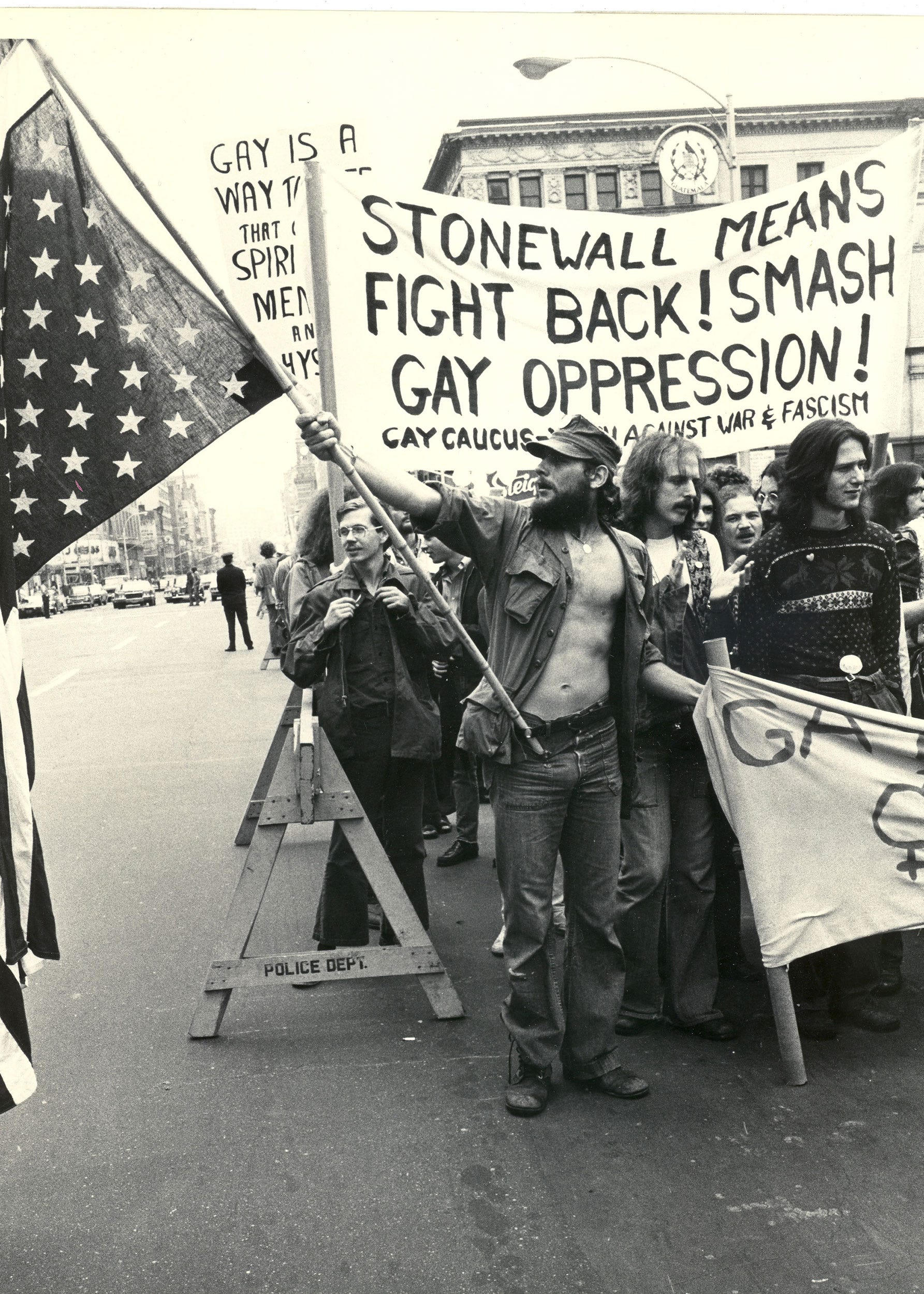
The real political question was never simply who gets added to the institution. It was why the institution exists as a mechanism of legitimacy in the first place.
Municipal ordinances recognizing polyamorous families shouldn’t just be the next chapter in the marriage equality story. This is our chance to challenge whether the state should have any authority at all to define who counts as family.
And yet, even before the law changes, there is a truth the colonial state cannot erase:
the law does not create kinship. It only formalizes relationships that already exist.
You are already a family.
The hospital does not decide that. The tax code does not decide that. A judge in a custody hearing does not decide that. The people you can count on to be in the room with you at the worst moment of your life: they are the answer to who your family is. The work ahead is making the world catch up to what you already know.
Sign the forms. Write your will. Call your council members. And in the meantime, do not wait for permission to call your people what they are.
Family.
Love is lawless.
Mechanicsofhuman (@mechanicsofhuman), “On relational mechanics,” TikTok, February 15, 2026, video, .